
Getting To Know: David Waite,
iPride’s Umpire In Charge
For most of us players and coaches at the Gay Softball World Series (GSWS), our shared responsibility is to show up on time, with our gear, uniform, and be mentally and physically ready to play.
But how do we know what complex to arrive at? Once at the complex, how do we know what field our game is on? How do the umpires know where to go to, and when? Who picked them and makes sure they’re qualified? Who placed the bases, measured the distances, and chalked the fields? Who makes sure there are enough balls on each field to last the day, and who gets more when and if they’re needed? Who makes sure there is water, bathrooms, and other basic necessities?
A tournament simply cannot happen without any one those game-essential logistics being taken care of. To make each of those things happen requires an army of volunteers who work all year, both separately and in concert with each other. And that’s just scratching the surface.
In this article we’re going to focus on one of those essential game functions, umpires. We’ll dive into how umpires get chosen, how they’re scheduled, and what all goes into making sure there are redundancies built into the system. Crucially, we’ll also explore what steps are being taken to make sure International Pride Softball continues to get the best-of-the-best now, and for years to come.
In this article, we get to know the iPride Umpire in Charge, the pride of Portland, David Waite.
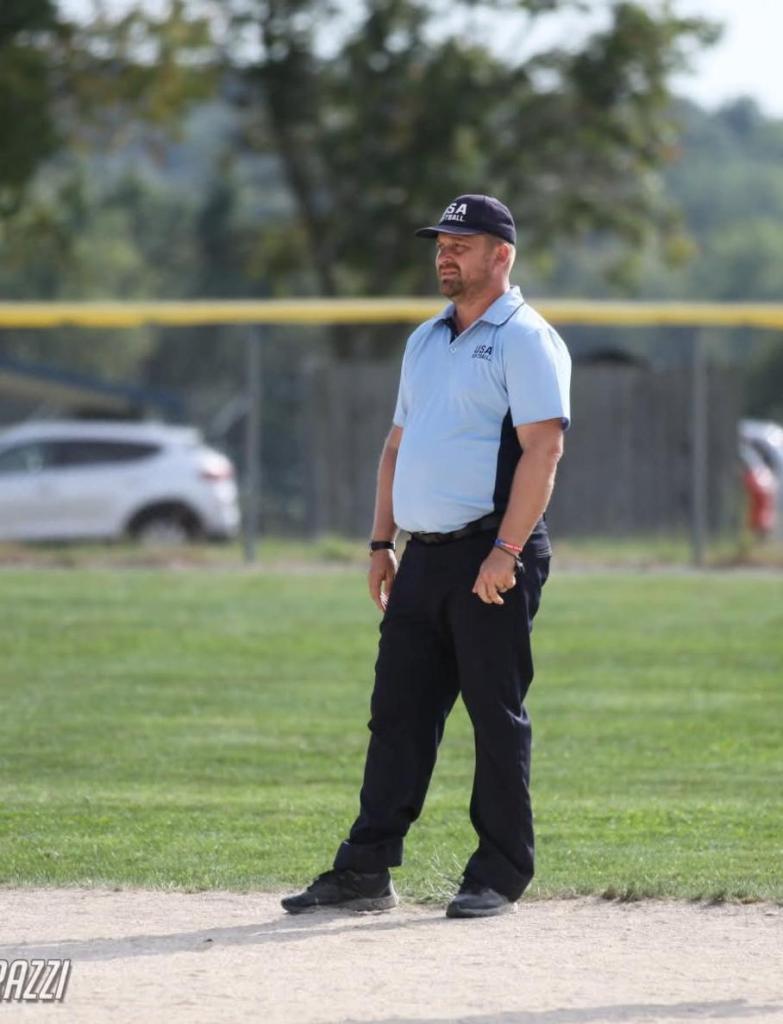
“When I was 21, I wanted to find a place where I belonged,” said Waite. “So I did some research here in Portland and found the gay softball league called Rose City Softball Association (RCSA).”
That was 2002. Since then, Waite would play, coach, and umpire, in his home league and just about everywhere else in the country.
In 2006 he would join the league’s board of directors as Secretary. Before long, he would transfer over to the role of Treasurer, a position he still holds. In 2010, he would stop playing and switch to managing and umpiring.
In 2012 he would first join the GSWS umpiring crew in Minneapolis. He has umpired in most of the GSWS tournaments since then. His work with USA Softball has earned him the status of Elite Umpire, and has resulted in invitations to umpire the Men’s A and Men’s Supers in Oklahoma City for the last several years.
What Is A UIC?
UIC is the acronym for “Umpire In Charge.” It’s a largely administrative and customer service role, with varying responsibilities depending on the league, tournament or association.
In 2016, Waite took over the UIC responsibilities for the rebranded Sin City Classic, a position he still holds. In 2022, he also became the UIC for International Pride Softball.
The biggest, most front-facing part of his job as UIC for these mega events is to make sure every game on the schedule has the requisite number of umpires. For iPride, that means two on the field at any one time, more as the tournament condenses and trophies are on the line.
Waite says that during the week of the GSWS, there are typically around 1,000 games from Tuesday to Saturday and he needs to make sure they all have two umpires. That number may seem incredible, but when you figure there are well over 200 teams competing, and each team is guaranteed no less than six games, you can see how quickly the tally can reach 1,000.
And the logistics only get more complicated. Those 1,000 games are spread out across four to six complexes, with seven distinct divisions playing on between 20 to 26 fields.
With those kinds of variables set into the system, the prudent thing to do would be to start scheduling several months out. Would that such planning were possible.
Waite and his team can’t begin to build their scheduling matrix until they get the actual schedule from the iPride Competition team, a committee made up of board members and volunteers from association leagues who work as quickly as possible to produce the mammoth document.

But the Competition Committee can’t even begin to build their schedule until all the teams from all around the iPride family have been locked in and confirmed.
There’s a reason deadlines exist, kids.
But even with justifiable administrative deadlines and the best of intentions, stuff still happens. Teams drop out at the last minute, umpires have to cancel, fields that were locked in suddenly become less available than originally planned. When any one of those things happen, scheduling often has to start from scratch.
Umpire Economics: 101
This may come as a surprise to folks, but umpiring queer and inclusive softball tournaments does not lead to fat stacks of cash.
Umpires have to pay for their own travel. They have to pay for their own rental cars. They even have to pay for their own hotels and food. While they do get a per-game fee and a per-diem from iPride, it isn’t much. Unless umpires find some way to cut their costs, many of them lose money each year.
Some of those cost-cutting measures include things like sharing hotel rooms with other umpire friends, and sharing the cost of rental cars. Waite takes that into consideration when drawing his umpire schedule, so that he can make sure to put umpires at the same complex who might be sharing a ride.
Meanwhile, umpires are expected to look professional, be up-to-date with the rules, well-versed in the mechanics of their roles (where they need to move as the play unfolds and how to predict where a play is going to go). They’re expected to hustle, every play, every game, and they’re expected to manage a game and deal with complaints and questions. They’re expected to de-escalate tension, even in the face of less-than-professional behavior from coaches and players who sometimes step over the line. In short, they’re expected to be the professionals that the USA Softball logo on their polo shirts commands.
So yeah, umpiring is not a get-rich quick scheme. But Waite says that isn’t why they do it. “They do it because they love the game, they love the association. Many have developed great friendships with the players and the other umpires. They do what they do year after year for the same reason all the players do, for the experience.”
And Then There’s Breaks
“I try not to have umpires work more than three games in a row,” Waite said. “You have to make sure they get breaks so they can eat, get something to drink, take a few minutes off their feet. It’s a lot.”
Waite said these breaks also serve another purpose. “I try to make sure that they are switching fields and partners without causing delays to the other games. You don’t want a game delayed because you’re waiting for an umpire to come over from another field.”
Waite says these rotations are popular. “It helps umpires stay on their toes and nobody, not the teams or the umpire, want to be with each other all day.”
But there’s another reason Waite makes sure to rotate umpires between fields. “It helps them enjoy the social experience as much as the players do. We like to be able to work with other members of our umpire family just like the teams that travel in like to play teams from other parts of the country.”
Getting By With A Little Help From His Friends
Scheduling the umpires and taking into account all of the logistical challenges isn’t the extent of Waite’s responsibilities. He also has to make sure adjustments happen in real time when they’re needed. If a game goes long and an umpire is supposed to get an hour break but now can only get 15 minutes because they have to move fields, Waite springs into action to adjust the schedule, both so the umpire can take a break and so the games can continue with minimal delays. If an umpire twists and ankle and is done for the day, or gets sick, or suffers from the heat, sometimes dozens of adjustments are required, and in the blink of an eye.
He does none of this by himself.
Waite has the support of four assistant UICs, qualified people who have been part of the iPride family for decades and some who are in or about to be in the NAGAAA Hall of Fame. They are: Bridgette Lahm, from Portland; Marcie Collie from Phoenix; Chris Atwood from Boston; and Kreg Harsha from San Diego.
Waite leans on these umpires to solve whatever issues come up, with or without his input. He trusts them implicitly. Typically one is “stationed” at each complex and Waite will travel between them all offering support, unless he’s required to staff a complex of his own. In that case he remains in contact with his team constantly, and throughout each day.
If a team questions a rule or rule’s interpretation, which they’re welcome to do, often the Assistant UIC will get involved and, if necessary, get Waite on the phone to provide guidance or interpretation. While this can delay things, Waite said his team, from the umpire on the field to the UIC team, all care about making sure the call is right.
Umpires Today And Tomorrow
Waite will have approximately 76 umpires for his year’s Gay Softball World Series in Houston. He spends the majority of the year trying to bring back the folks who have worked at previous events, and finding new talent as the event expands.
It’s not an easy job, and with fewer and fewer people willing to take on the role of sports official, it’s becoming increasingly difficult. These and other challenges have forced Waite to become innovative and highly adaptable.
As the iPride family of umpires continues to age, and players themselves are playing longer and longer and not joining the blue crew quite as early as they used to, Waite has had to get creative.
Part of that creativity has included taking advantage of relationships with USA Softball and forging stronger bonds, including providing a space for training that often isn’t available.
Waite has leveraged his status as UIC for the Sin City Classic to help.
“Next year at the Sin City Classic I am hosting the USA Softball Advance Camp,” Waite said. “For the umpires who are wanting to step up to the next level, it’s two days of training and three days of working games.” Those games will be across a variety of skill levels, which will test the umpires’ ability to not only adapt to different paces of play, but also their ability to confidently manage the unique personalities of managers and players from across the spectrum of play.
But Wait, There’s More
While Waite has been able to build upon the work of the UICs before him, he has also helped to modernize the practice. He now utilizes a software program that he and his team of Assistant UICs can use to make scheduling changes in real time, and that points out any discrepancies or conflicts before going live.
The system even doubles as a payment system so, once all the games have been completed for the week, and all the games the umpires have worked have been confirmed, Waite is able to make the funds available for the umpires in minutes, rather than forcing the iPride Treasurer to write 80 different checks and mail them all out a month or two later.
“We’ve been able to modernize a few different things,” Waite said, “and it’s been a big time-saver for everyone.”
At the end of our conversation, Waite made me promise to include an invitation to anyone wanting to explore becoming an umpire to reach out to him at UIC@ipridesoftball.org. He also wanted to include an invitation to any local associations that may need more umpires for their tournaments to feel free to tap into his national resources by emailing him at the same email address.
Waite will be inducted into the NAGAAA Hall of Fame in Houston later this year. It’s an honor that’s well deserved. Now, if only he knew someone who could schedule him being there…