
Getting To Know: Richard “Rosie” Jimenez

There’s no One Way signs on the road to coming out. For some, the journeys have perilous curves, sudden U-turns, and even forks that lead down diverging roads. Thirty-five years ago, Richard “Rosie Jimenez came to a fork in his road to self-acceptance, and he chose to go left. To quote Robert Frost, “that has made all the difference.”
Jimenez grew up in the rough Compton neighborhood, full of machismo and an almost automatic mistreatment of queer people.
“I would see how the Trans girls would get treated in my neighborhood,” Jimenez said. “They would get beaten up. The guys would throw bottles at them. I didn’t really know what being gay was all about, but I knew I didn’t want anyone to know about me, if that’s how I was going to be treated.”
By the time he was 21, Jimenez knew he had feelings toward men but he hid them behind a mask and addictions to drugs and alcohol.
“I identified as straight, I had a girlfriend, the whole nine yards.” But, Jimenez said, he wasn’t totally cut off from the queer community. “I had gay friends, but they knew I was straight.”
Jimenez was social enough with those gay friends that occasionally he would go out with them to their bars, including one night to Ripples in Long Beach.
In a tale as old as time, it was a visit to the Ripples bathroom that would change everything.
“I saw a flier on the wall that invited people to come out and play for the Ripples gay softball team,” he said. It was one of those old-school fliers that had perforated slips at the bottom with a name and phone number that teared away so you could take the info with you but leave the flier.
Over the next few days, Jimenez wrestled with himself about what to do next.
“I must have dialed that number a million times, but I hung up before it would even ring.” Finally, one night when his parents were gone and he found himself alone in the house, he picked up the phone and called. “Rudy answered and told me about a practice they were having on Saturday and where to go. I wrote down the directions and said I’d be there.”
When that Saturday came, Jimenez left the house and followed the directions he’d written down as best he could. But when he came to the end, he had trouble. “I couldn’t read the rest of the directions.”
At one point he came to a fork in the road, and he had to choose to go left or right. His directions were useless so he had to look for clues. He looked up and out, and to the left he saw a group of people playing softball that he instantly concluded must be gay. So he pulled over to the left and stopped in the parking lot.
“I must have sat there for 20 minutes,” he said. He was nervous, and too afraid to be associated with what he judged as a bunch of flamboyant people frolicking in the park.

“I must have sat there for 20 minutes,” he said. He was nervous, and too afraid to be associated with what he judged as a bunch of flamboyant people frolicking in the park.
After almost a half hour, another car pulled up and a guy got out who looked to Jimenez to be pretty athletic.
“So I asked him if he was here for the gay softball. He said ‘Yes.’”
Determining there was strength in numbers, Jimenez headed toward the fields with this man and started practicing with the team.
Once Jimenez saw those folks on the field, being themselves, it forced him to come to terms with the fact that being gay, feeling the way he did, was more than just the phase he’d hoped it to be. He now had to cope with the fact that being gay was who he was, and was always going to be. His response was to go deeper into the closet.
“I started drinking even more and doing more drugs,” he said. “I don’t know how I was functioning.” But even though Jimenez started swirling into that downward spiral, he kept going to softball.
“It was my safe space. It was my only safe space.”
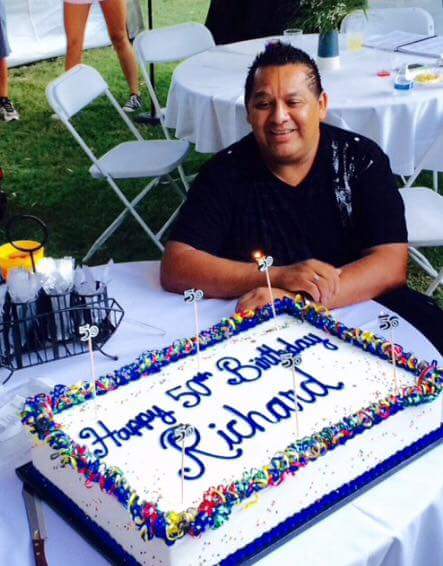
For Jimenez, his “bottom” would come in the form of an overdose. “That was my wake-up call,” he said. “I quit, cold turkey.”
He also changed geography and moved his softball life to Los Angeles. “I had to get out of Long Beach. If I’d have stayed I probably would have had another overdose.”
Although on a map, L.A. and Long Beach are right next to each other, in almost every measurable way, they are a world apart. That chasm was exactly what Jimenez needed.
After a year of playing in the Surf and Sun Softball league in Long Beach, the team Jimenez played on moved to the Greater Los Angeles Softball Association (GLASA) because the sponsor bought a bar called Trunks. Jimenez said the new owner wanted to turn it into a gay sports bar in West Hollywood. “He thought having a softball team in GLASA would help with that.”
For the next several years, Jimenez would play and coach in GLASA, and in tournaments all over, still identifying as a straight man, even while dating men on the down-low.
While this duality tore at him, it was enough exposure to the queer world that Jimenez was able to stay away from spiraling into his addiction. “I got to be gay on the weekends with my softball family,” he said. “During the week I didn’t need the drugs, and I didn’t need the booze because I knew that when Friday came, I could be with my softball family and wouldn’t have to hide.”
After 5 years, Jimenez slowly started coming out to friends and family. “One by one I called my close friends to tell them,” he said. “They all told me they already knew!”
Over his 39 years in queer softball, Jimenez has earned his place. He has coached teams for most of that time, helping younger players find their refuge, their safe space, hundreds of times. He has led teams to championships, and he’s given his heart and soul to more souls than he can count.
When I asked him if that 21-year-old kid struggling to dial that phone number would be proud of the man he’s now become, Jimenez didn’t hesitate.
“I would be very proud. I’d be proud because of the family that I’ve built around me. I’m proud of the accomplishments I’ve made. I’m proud of where I’m at, after what I’ve been through. Do I understand how all that happened? Maybe not, but I’m proud of who I’ve become.”
A big part of who he has become was due to Jimenez’s partner of nearly 34 years, Barry. So when Barry passed away this past April, Jimenez found himself at another fork in the road, and just like that Saturday morning all those years ago, he wasn’t sure how to carry on.
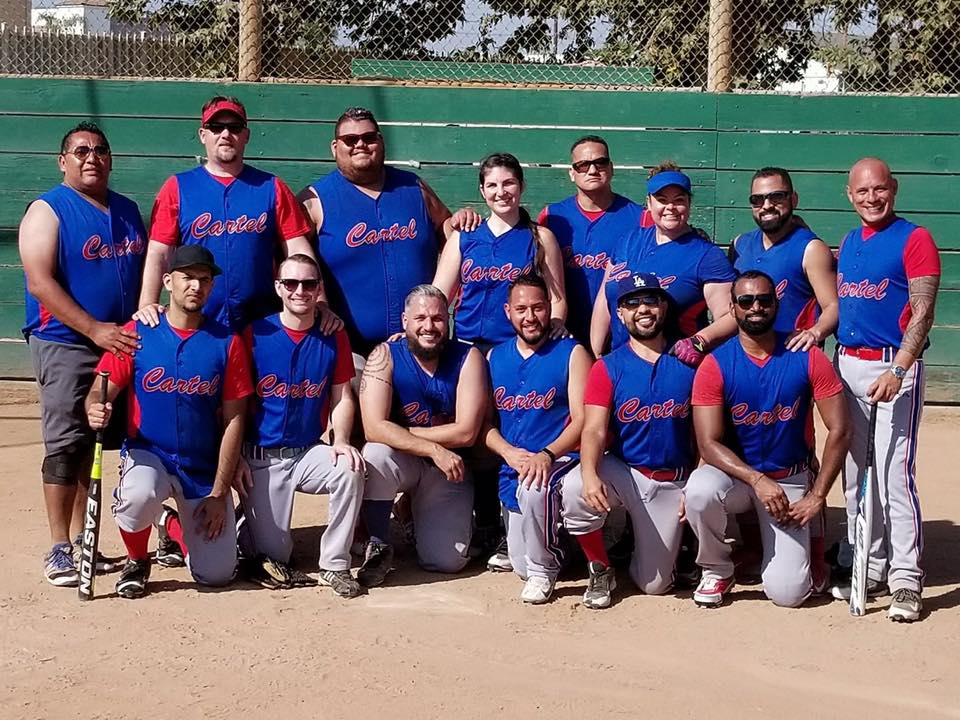
But once again, the softball community showed him.
“It was tough but my softball family stepped up,” he said. “They were here. They reached out to me. The phone calls, the love. It was overwhelming unconditional love.”
Jimenez said that the love came from all corners of the league, “Not just the teams I’m associated with, but the league as a whole was there for me. It was more than I could ever imagine.”
Surprisingly the loveable veteran was unaware of the love that he’d earned. “I didn’t know how much the league loved me, or how much I meant to them. But they showed me,” he said.
In addition to coaching or managing seven different teams in GLASA, Jimenez also plays in the B Division and is a USA Championship certified umpire in both slow-pitch and fastpitch He has also umpired in tournaments around the country.
In 2009 Jimenez was inducted into the GLASA Hall of Fame. In 2015 he was inducted to the NAGAAA Hall of Fame, and in his speech, he talked about how going left in that fork in the road saved his life.
Although the result of a difficult loss, Jimenez now knows just how many lives he’s saved along the way.
PS… There’s a really funny story about how “Rosie” came to be how this legend is known. Ask him about it sometime.